Update, October 2026: Memory Insights have taken a new direction since this was written. The History tab, the weekly reflection, streaks and match scores mentioned below have been replaced by a written account of your week, month, quarter and year. The rest of the article still stands. Read what changed.
A career transition journal is a record of a change while it is still happening — not the account you will give afterwards, once the ending has tidied everything into a decision.
That distinction is the whole reason to keep one, and it is also why the app you choose matters more here than for ordinary journalling. A transition runs for months, moves in phases rather than days, and the value arrives when you reread it a year later. Most journalling apps are optimised for the entry. This is a use case optimised for the archive.
What to look for
It has to survive a year of uneven use. Transitions have flat months. An app built around streaks will make a quiet March feel like failure and you will quit in April.
You need to find things again. In eighteen months you will want the week you nearly stayed. If retrieval means scrolling, you will not do it.
Long-arc views, not just a calendar. A month grid tells you nothing about a transition. You want to see the shape across the whole period.
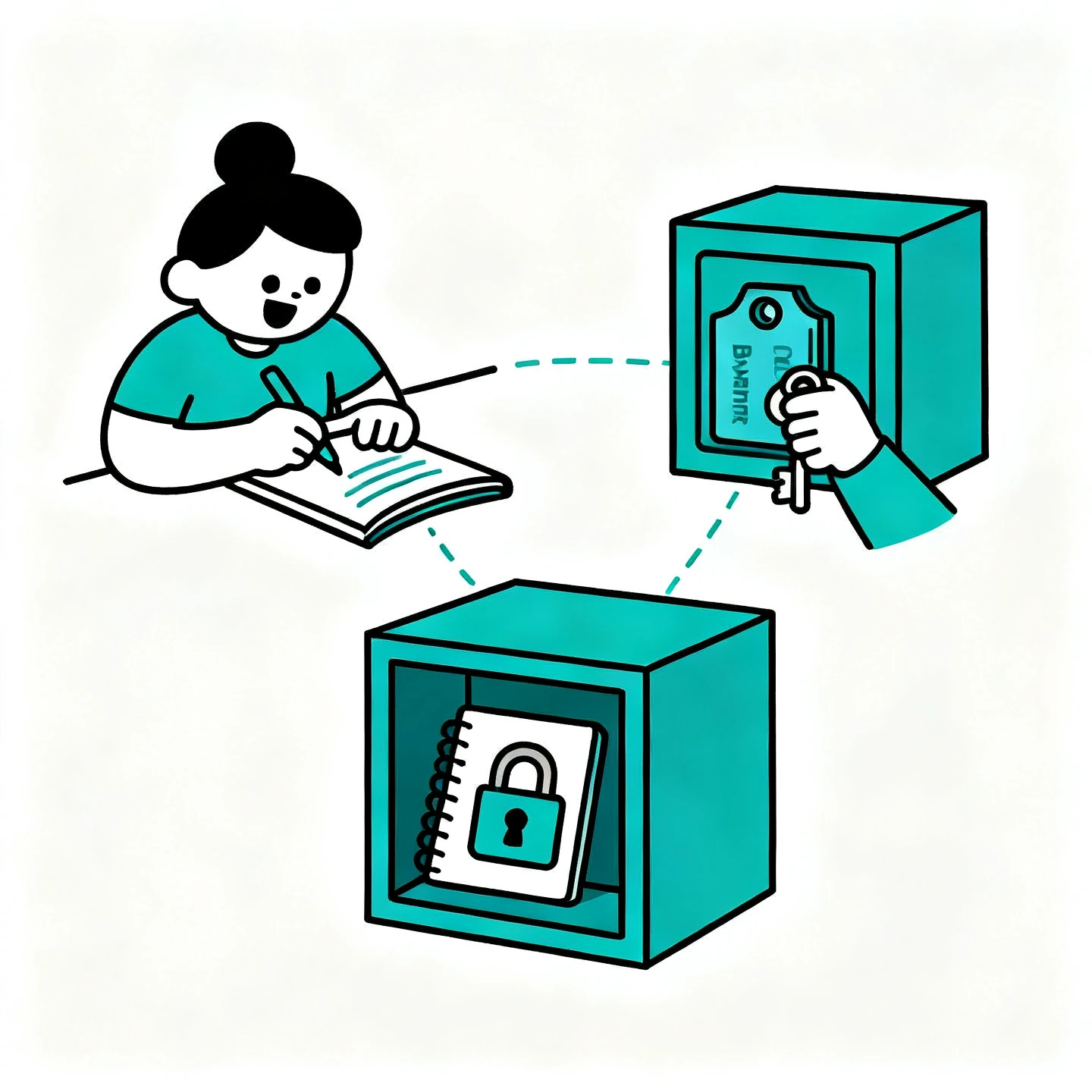
Private by default, shareable later. During a transition you are writing things you would not say at dinner. But afterwards, some of it is genuinely useful to someone three months behind you — and that should be a decision you make later, not a setting you had to choose upfront.
Honest about where your writing goes. Career transition entries name employers, salaries, colleagues and fears. Read what the app actually claims about encryption and about AI processing, not what the landing page implies.
How Deeditt handles it
Deeditt is built around the shape a transition actually has, which is the main reason it fits this use case better than a dated notebook.
The structure matches the thing
You write entries — Deeds — and group related ones into a Journey: a collection that documents a process over time. A career transition is one Journey with entries running from the first unease to the first month in the new role. That is a different object from a folder of dated notes, and it is the reason the archive stays readable.
We publish a five-phase template for exactly this, laid out in full on the page — nothing to download, no email required. If you would rather have questions than a structure, there are weekly prompts built for the middle of a transition.
Writing it costs nothing
Memories is the private journaling space, and writing, reading and deleting entries there is free on every plan. A transition journal is one you will want private while it is happening, and you do not need to pay for that.
What Pro adds, and why
Pro is $4.99/month or $49.99/year. For this use case the parts that matter are the long-arc ones: the history view with its weekly archive and annual chapters, the weekly reflection, and the recurring patterns drawn across entries far apart in time. Those are the surfaces that make a year of writing readable rather than merely stored.
The line follows what things cost to run, not what is private: writing an entry is cheap, and the analysis built on top of it is not. Pro also covers private publishing of Journeys and Deeds, and shared Journeys.
Two things stated plainly
Deeditt is not end-to-end encrypted. Entries are encrypted at rest and in transit and are private from other members, and the encrypted content, the keys and the credential that unlocks them are each stored in a different system. But Deeditt generates and holds those keys, so we are not going to tell you we are cryptographically unable to read anything. If that guarantee is a requirement for writing about your employer, an end-to-end app is the better choice and we would rather say so here.
The analysis is opt-in and off by default. If you never enable it, no entry of yours is decrypted for analysis. If you do, the entries for that period go to external model providers to generate the weekly reflection, without your name, email or account identifier attached. Your mood, sleep and energy history is different — that is computed from structured metadata with no model involved at all.
The case for starting before you are sure
Most people begin a transition journal once the decision is made, which means the most useful part — the months of not knowing — is already gone.
The baseline entry is the one worth writing today: where you stand, what works, what does not, and what would have to be true for you to stay. It takes fifteen minutes and it is unreconstructable afterwards. Once you know how it ended, you cannot write it honestly any more.
If you want the longer argument for why that period disappears, it is here. If you would rather just start, Memories is free and the first entry is the baseline.