Update, October 2026: Memory Insights have taken a new direction since this was written. The History tab, the weekly reflection, streaks and match scores mentioned below have been replaced by a written account of your week, month, quarter and year. The rest of the article still stands. Read what changed.
Three apps, three different bets on what a journal is for. Day One treats your journal as a vault. Journey treats it as data you should own outright. Deeditt treats it as writing that starts private and can become useful to other people, if and when you decide it should.
All three are good. They are good at different things, and the honest comparison is about which trade-off you want.
The short answer
- Day One if cryptographic privacy is the thing you will not compromise on. It is the only one of the three where the company genuinely cannot read your entries — including the ones you share with other people.
- Journey if you want to own the storage. Keep entries in your own Google Drive, or self-host on your own server with Docker.
- Deeditt if your writing is meant to connect with other people’s. Collaborative journeys with no participant cap, and a community layer the other two do not have.
In one sentence: Day One is the most private, Journey is the most portable, Deeditt is the most connected.
Side by side
| Day One | Journey | Deeditt | |
|---|---|---|---|
| Free tier | Yes | Yes | Yes |
| Paid price | Silver $49.99/yr · Gold $74.99/yr | $6.99/mo or $49.99/yr · $34.99 one-time, single platform | Pro $4.99/mo or $49.99/yr |
| Private journaling on free | Yes | Yes | Yes — writing in Memories is free on every plan |
| End-to-end encrypted | Yes, private and shared journals alike | Encrypted cloud, or your own Drive, or self-hosted | No — server-managed encryption, keys held by the service |
| Collaborators per shared journal | 30, including the owner | Shared journals supported | No cap |
| Who pays to collaborate | Creator needs Premium; invitees free | Paid membership | Creator needs Pro; invitees free |
| Public or community layer | None | None in-app; can publish to WordPress or Tumblr | Yes — public, community or private, set per Deed and per Journey |
| Self-hosting | No | Yes, via Docker | No |
| AI features | Gold tier: Daily Chat, Entry Highlights, Go Deeper | Coach guided programs | Memory Insights and writing assistance (Pro, opt-in) |
Day One: the strongest privacy guarantee here
Day One has been the reference point in private journaling since 2011, and its encryption story is the most complete of the three.
The part that matters most is what happens when you share. Day One’s Shared Journals, which let a group document something together, carry the same guarantee as your private ones. Day One’s own documentation is unambiguous: “All Shared Journals are end-to-end encrypted. Even Day One can’t access your journal or any content within your journals.”
That is a real guarantee, enforced by mathematics rather than by policy. Very few products that offer collaboration can say it.
The constraints are worth knowing. Shared Journals cap at 30 members including the owner — generous for a family or a small team, a hard ceiling for anything larger. Creating one needs a paid plan, though anyone you invite can read, comment and add entries for free. And there is no public layer at all: sharing happens only with people you name.
Day One wins if you write things where provider access is unacceptable — therapy work, medical detail, legal matters, anything you would not want readable under any circumstance.
Journey: own the storage
Journey’s distinguishing bet is portability. You can keep entries in Journey’s encrypted cloud, route them through your own Google Drive, or self-host the whole thing on your own server with Docker. That last option is rare enough to be the main reason people choose it.
It also supports shared journals, password-protected web links for individual entries, and plugins that publish straight to WordPress or Tumblr — so a private reflection can become a public post without leaving the app. What it does not have is a community inside the product: no feed, no other people’s journeys to read.
Pricing is the most flexible of the three. A membership runs $6.99/month or $49.99/year across every platform, or you can buy a one-time Premium licence for a single platform at $34.99.
Journey wins if data ownership is the priority — if “where exactly does this file live” is a question you want to be able to answer precisely.
Deeditt: private writing that can become shared
Deeditt starts in the same place as the other two. Memories is the private journaling space, and writing in it is free on every plan — creating, reading and deleting entries, on the free tier, with no cap.
Where we are less private than Day One
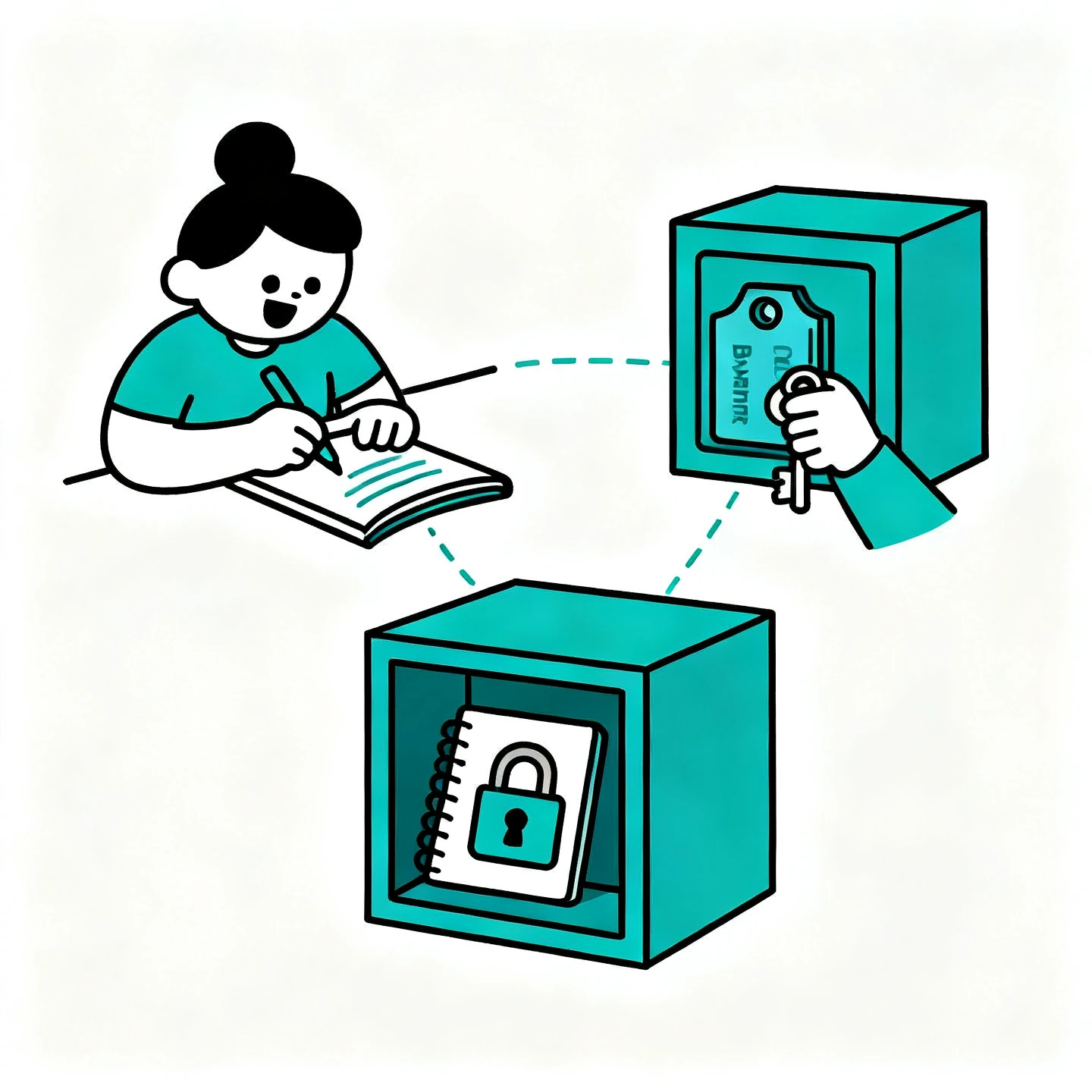
Deeditt’s encryption is hybrid: each entry is encrypted with a random AES-256-GCM session key, and that key is then encrypted with your RSA-2048 public key. The keys are generated on the server when you register.
That last detail is the whole difference. Deeditt is not end-to-end encrypted, and we are not going to describe it as if it were. In a true end-to-end system your key is created on your device and never leaves it, which is why the provider cannot read anything even if compelled to. Ours is server-managed, so that guarantee does not apply.
What is true, and what we will claim: entries are encrypted at rest and in transit; they are private from other members; and the encrypted entry, the private key that opens it, and the passphrase that unlocks that key each live in a different system. An attacker needs to assemble all three. A stolen database yields unreadable ciphertext; stolen key files open nothing on their own.
That is a description of what someone would have to do, not an absolute promise. If you need the absolute promise, Day One is the better product for you, and we would rather you read that here than discover it later.
Where Deeditt does something the other two do not
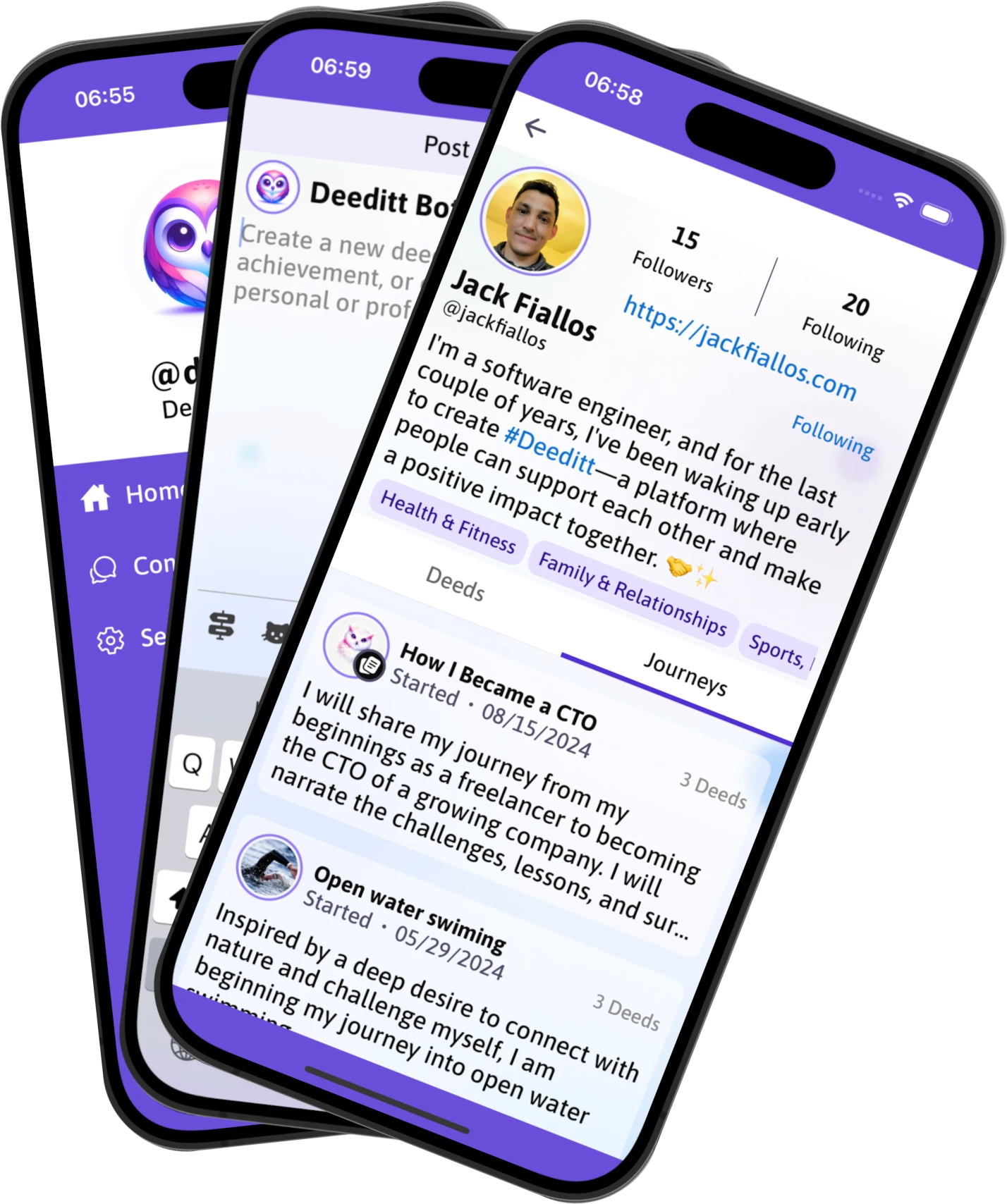
Journeys and Deeds. A Deed is a single moment. A Journey is a collection of them that shows a process over time — a career change, a first year of parenting, a recovery, a project.
Journeys can be collaborative. Invite people and each of them adds their own Deeds, in their own voice, to the same story. There is no cap on collaborators, which is the practical difference against Day One’s 30. Creating a shared journey needs Pro; the people you invite participate without paying.
And every Deed and every Journey carries its own visibility: public, community — visible to Deeditt members but not the open internet — or private. You write first and decide afterwards.
What Pro costs and what it adds
Free is $0 and covers writing in Memories, reading, and publishing publicly or to the community. Pro is $4.99/month or $49.99/year. It adds Memory Insights, AI writing assistance, private publishing for Journeys and Deeds, and shared journeys.
The boundary follows cost, not privacy: writing an entry is cheap, so journaling is free. The analysis built on top of your writing is expensive to produce, so it sits behind Pro.
Insights is also opt-in and off by default on every account. When you switch it on, the entries for the period are decrypted and sent to OpenAI and Cohere to generate the weekly reflection and connect distant weeks. Nothing is analysed until you ask for it. Your mood, sleep and energy cards are different — those are computed from plaintext metadata without any model involved.
What you actually pay
At the annual price, Day One Silver and Journey’s membership and Deeditt Pro all land at $49.99. The differences are at the edges: Deeditt is the cheapest month-to-month at $4.99, Journey is the only one selling a one-time licence, and Day One’s AI features sit in a higher $74.99 tier rather than the base one.
Which one should you choose
Choose Day One if the provider being cryptographically unable to read your journal is a requirement rather than a preference — and if a 30-person ceiling on shared journals is fine for what you have in mind.
Choose Journey if you want the storage under your control, especially if self-hosting appeals. It is the only one of the three that offers it.
Choose Deeditt if the writing is meant to be shared eventually: a couple keeping a relationship record, a family building something across generations, a team documenting a project, or anyone who wants private reflection and a community of real experiences in the same place. The uncapped collaboration and the visibility controls are the reason to be here.
Use more than one. Nothing stops you keeping the most sensitive material in Day One and the shared, outward-facing work in Deeditt. Plenty of people do exactly that, and it is a more honest recommendation than pretending one app should hold everything.
The point of the comparison
Journaling apps tend to be sold on feeling rather than on mechanics, which makes them hard to compare. The mechanics here are simple enough: Day One buys you the strongest privacy guarantee and accepts a participant limit and no public layer. Journey buys you ownership and accepts that you own the backup problem too. Deeditt buys you collaboration without a ceiling and a community layer, and accepts that its encryption is server-managed rather than end-to-end.
Pick the trade-off you can live with. That is the whole decision.