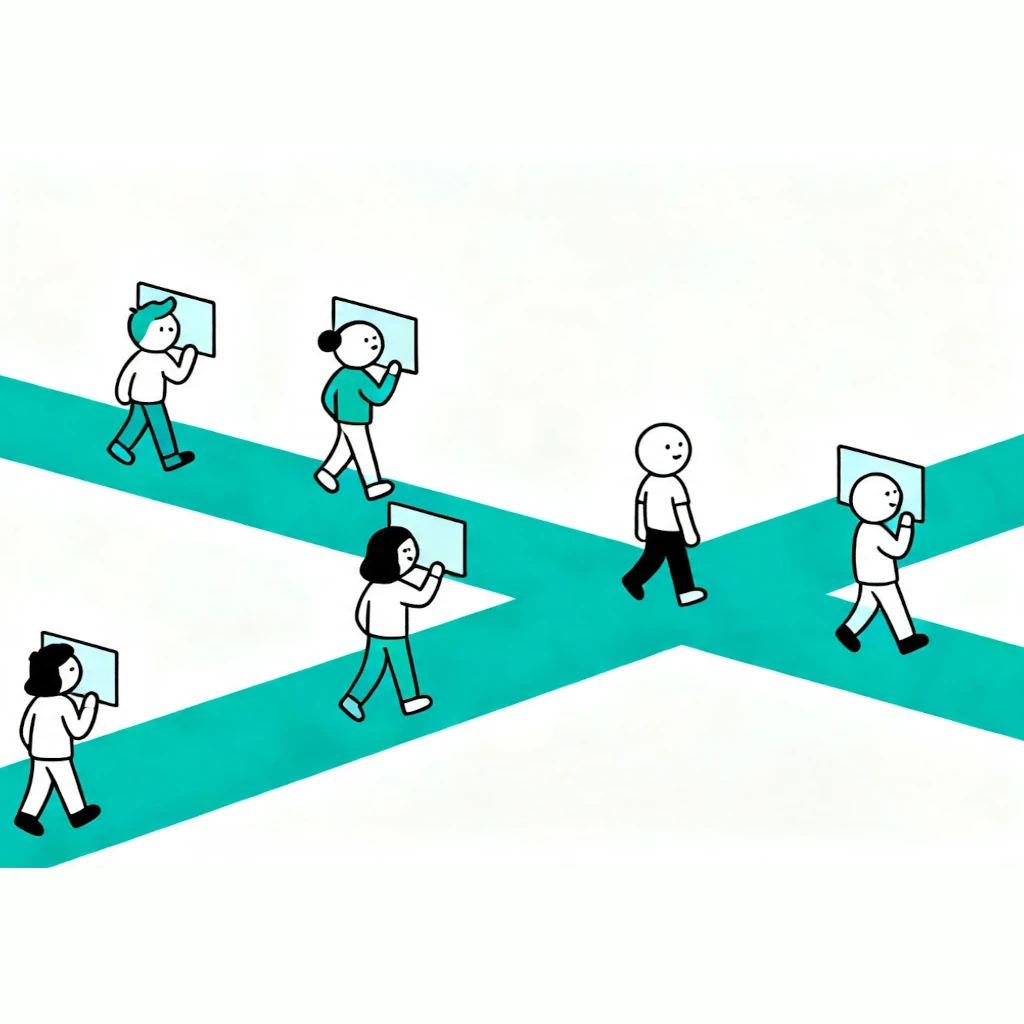
There is a particular kind of tiredness that comes with changing careers, and it is not the tiredness of the work. It is the tiredness of explaining.
You explain to your manager. You explain to your parents. You explain at dinner, to someone who asks what you do and then waits. Each time you produce a slightly cleaner version — one that sounds decided, sounds reasoned, sounds like a plan. And each time the gap widens between the version you say out loud and the version you are actually living, which is messier, more frightened, and considerably less sure.
That gap is the real cost of a career transition. Not the money, though the money matters. The gap.
What the noise does
Search for help with this and you will find an enormous amount of advice, most of it confident. Frameworks for finding your purpose. Threads from people who left and never looked back. Posts announcing the leap, always written after it worked out.
Almost none of it is written from inside the middle, because the middle is not a good story yet. Nobody publishes the eight months where they were interviewing and not getting anywhere and were not sure whether that meant persist or stop.
So you read the confident versions and measure your uncertain one against them, and conclude you are doing it wrong. You are not doing it wrong. You are reading edited outcomes and comparing them to your unedited process.
The thing you will want later and cannot reconstruct
Ask anyone two years past a career change what it was like and you will get a summary. Clean, causal, slightly wrong. I realised I wasn’t happy, so I retrained, and now I do this.
That is not what happened. What happened was a hundred small readings of the situation, most of which they no longer remember. The week they nearly stayed. The conversation that shifted something. The specific fear underneath the general one — not “will this work” but “will my father think I wasted the degree.”
Memory smooths transitions into decisions. It does this to be kind, and it destroys the only record that would have been useful: what you actually thought, before you knew how it turned out.
That record is worth something to precisely two people. You, in a future transition — because there will be another one, and you will have forgotten how you got through this. And someone else at the start of the same thing, who needs to see the middle rather than the announcement.
Writing it down is not the same as journalling about your feelings
A useful record of a transition is more specific than a diary and less performed than a post.
It holds the state of play at a moment: what you were weighing, what you feared, what you had ruled out and why. It is written in the present tense of not knowing. Its value comes entirely from the fact that it was written before the outcome existed.
That is also why it cannot be reconstructed afterwards. Once you know how it went, you cannot un-know it, and everything you write about the period reorganises itself around the ending.
What this looks like in practice
Not daily. Career transitions do not move daily, and forcing an entry out of a week where nothing happened produces nothing worth rereading.
Weekly is closer. One entry, fifteen minutes, on the same day. Enough that you catch shifts while they are still shifts and not yet conclusions.
If it helps to have somewhere to start:
- Prompts for a career change — the questions worth asking when you do sit down, and the ones that produce nothing.
- A structure for the whole transition — a template you can fill in on the page, organised around the phases a transition actually has rather than around dates.
- Documenting professional growth more broadly — the same practice applied to a career you are staying in.
The part about noise, again
Deeditt exists for this specific gap. Not as a productivity system and not as a place to broadcast a decision before you have made it. As somewhere quiet enough to write the unedited version, where there is no feed ranking your uncertainty against someone else’s announcement.
You write in Memories, which is private and free on every plan. If, later, some of it turns out to be worth handing to someone else at the start of the same road, you can shape it into a Journey and decide then who sees it. Most of it will stay private. That is the normal outcome, not a failure of the exercise.
There is a version of this article that would end by telling you writing will make the transition easier. It will not, necessarily. Some of it is going to be hard regardless of what you do with a notebook.
What writing does is stop the period from disappearing. In two years, when you are summarising it into three clean sentences for someone at a dinner, you will have the real thing to check yourself against.
That is a smaller promise. It is also the one that holds.
Try it on paper
When the transition also means changing country, the questions change with it. Moving Abroad Journal — free, printable, and yours to keep.