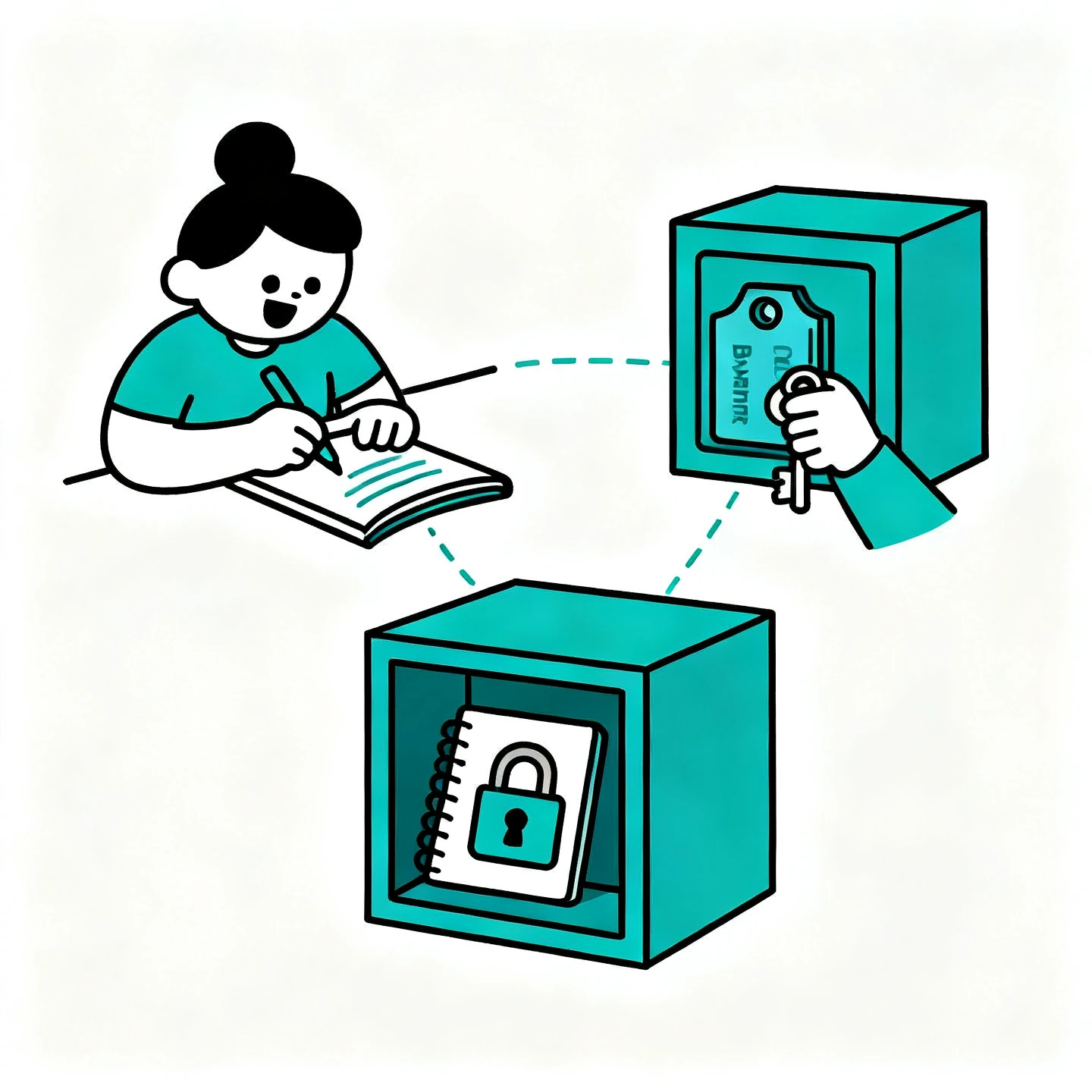
In the previous article, we covered where the keys to your Memories live: your entries are encrypted before they’re saved, and they’re never stored in plaintext anywhere in our systems. Nothing below changes that.
What does change, if you decide it should, is whether anyone can read them.
Private by Default, No Exceptions
Every new Deeditt account starts with Insights turned off. This isn’t a setting we leave on and hope you’ll eventually find to disable — it’s the opposite. The option lives off in the database from the moment the account is created, and it stays that way until you turn it on.
While it’s off, your entries sit encrypted, at rest, with no process — ours or anyone else’s — opening them. You can write for years without a single word ever being read by anyone.
What Changes When You Turn It On
Turning on Insights is an explicit instruction. When you flip that switch, that’s literally what happens: we tell our internal processes that from that point on, they’re allowed to decrypt and look at what you write, in order to produce three things.
The first is a short account of each period: a few lines about your week, a page about your month, something closer to a short story about your year. It’s written from your own entries, in your own words, so reading it feels more like remembering than reading a summary. This is what we call an insight.
The second is continuity tracking. The system identifies the people, projects, and topics you name, and follows them over time so it can tell you which ones are still open, which are new, and which you’ve already closed. Those names are stored encrypted and never leave attached to your account.
The third is memory, in the plain sense of the word: it hands back what you already wrote, when it becomes relevant again. The same date a year ago. A line from months back that resonates with this week.
For all three to work, the text of your entries and the dates you wrote them leave our systems and go to an external service that does the analysis. For the weekly account, how you slept and how you felt travel too — but only as general categories, “most days”, “sometimes”, never as exact figures. What never travels, under any circumstance, is your name, your email, or anything that identifies the account. What gets sent is a stretch of writing, not a file with your identity attached to it.
What “No Name” Does and Doesn’t Cover
Stripping your name from the account doesn’t make what you write anonymous. If you mention your boss by her first name, the city you moved to, or the knee surgery you’re recovering from, that text still points to exactly one person. That’s simply what a journal is: the specific details of a specific life.
It’s also worth being precise about what kind of guarantee each piece is. Encryption is a property of the system: it holds by design, no matter who you trust. That this text isn’t used to train third-party models is a contractual clause with our provider, standard across the industry, and that’s how we pass it on to you. It’s no less real, but it’s a different kind of guarantee — one is held up by engineering, the other by an agreement between companies.
Turning It Off
The switch works the same way in both directions, from your Memories settings, whenever you want. Turning it off stops future analysis: no new period gets opened, and nothing new gets sent to the external service. Whatever was already processed before you turned it off doesn’t get undone retroactively, but nothing new leaves your account until you turn it back on.