Every family has a period nobody wrote down. The years when the grandparents were still telling stories. The move that reshaped everything. The stretch when a parent was ill and the household reorganised itself around it. The details were obvious to everyone living through them, so nobody recorded any of it, and now they are gone.
A family memory journal is the attempt to not let that happen again — and the useful version of it is not one person writing on everyone’s behalf.
The problem with the one-historian family
In most families there is a designated rememberer. One person who keeps the photos, knows the dates, tells the stories at the table. This works until it doesn’t.
The single-historian model has three failure points. It captures one perspective — usually a parent’s, rarely a child’s. It captures one generation’s framing of events the other generation experienced completely differently. And it ends when that person does, which is precisely when families discover how much was only ever in someone’s head.
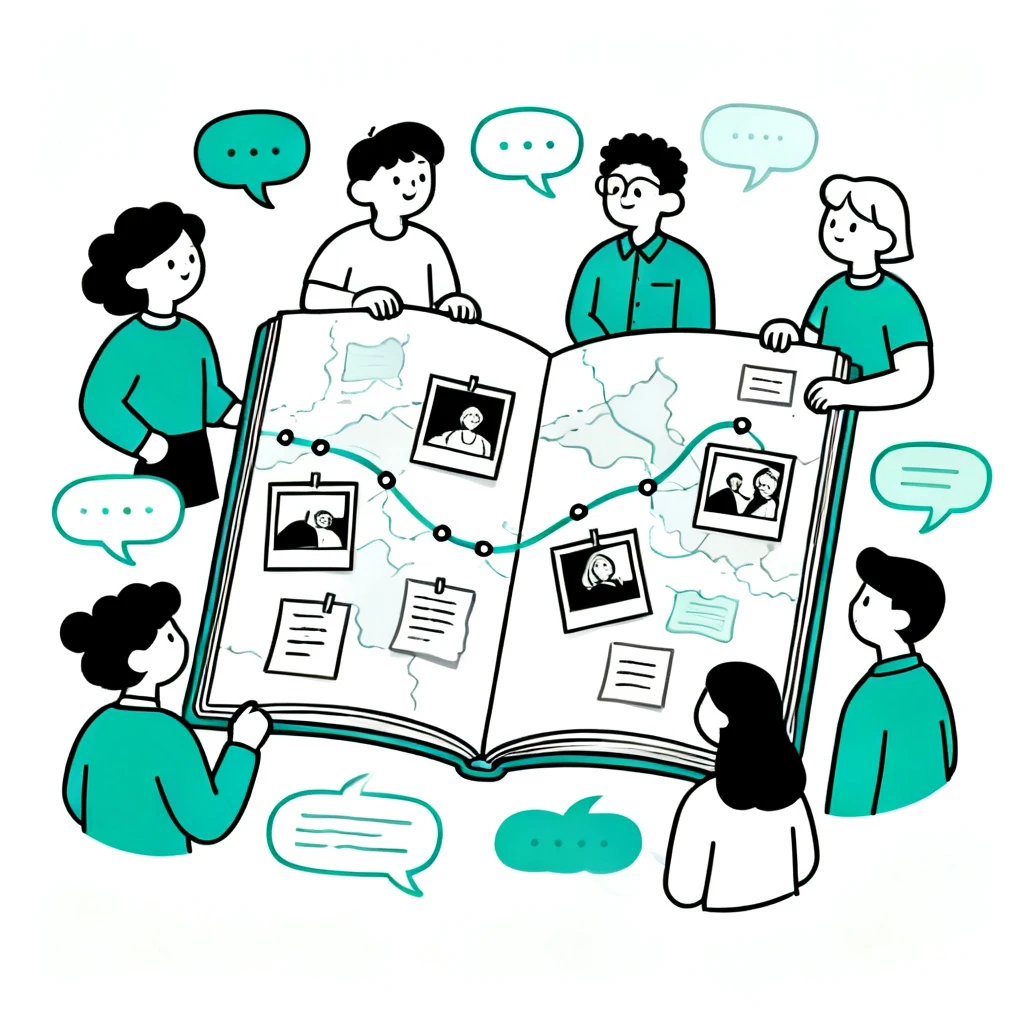
A family memory journal built for multiple contributors avoids all three, because the record is not dependent on any one person continuing to keep it.
What a family memory journal is actually for
Not a scrapbook. Photographs already solve the problem of what things looked like. What is missing is what people thought was happening.
Concretely, families use one to hold:
- A grandparent’s own account, in their own words, while it is still possible to ask for it.
- Both sides of the same childhood. What a parent remembers about a year, and what the child remembers about the same year, are reliably different documents.
- A move, an emigration, a rebuild. Anything where the family before and the family after are meaningfully different.
- An illness or a caregiving period. Often the least documented and the most consequential.
- The ordinary years. The ones nobody thinks are worth recording, which are the ones people most want back.
What to look for
More than one contributor, genuinely. Read access is not contribution. Each person needs to be able to add their own entries.
No per-person cost. A family is four, six, twelve people. If everyone needs a subscription, it will not happen. Check whether invited people participate free, and whether there is a cap on how many you can invite.
Room to grow. Families are not fixed-size. A journal that caps at a number you might exceed is a journal you will have to migrate.
Private by default, with an option later. Most family records should not be public. Some — a grandparent’s account of a war, an emigration story — are worth sharing eventually. You want that to be a decision, not a default in either direction.
Export. This is a multi-decade artefact or it is nothing.
How this works in Deeditt
A Journey in Deeditt is a collection of moments — Deeds — documenting something over time. A family memory journal is a shared Journey: you create it, invite people, and each of them adds their own Deeds in their own voice.
There is no cap on collaborators. This is the practical difference against most alternatives, which limit shared journals to a fixed number of people. A family that starts with four and becomes eleven over a decade does not hit a wall.
Only the person who creates the Journey needs Pro — $4.99/month or $49.99/year. Everyone invited contributes for free. For an extended family that is one subscription for the whole record.
Visibility is set per Deed and per Journey: private, community — visible to Deeditt members but not the open internet — or public. A family journal will usually be private. If a particular story turns out to be worth sharing more widely later, that is a per-entry decision, not an all-or-nothing switch.
The limits, stated plainly
Everyone invited has the same level of access. There are no reader-only roles, no per-person permissions, no way to give a teenager write access to their own entries but not to a grandparent’s. If you invite someone to the Journey, they can contribute to it the way you can. For most families this is fine; for some it is a real consideration, and it is better to know before you invite twelve people.
Deeditt is not end-to-end encrypted. Entries are encrypted at rest and in transit and are private from other members, and the encrypted content, the keys and the passphrase that unlocks them are stored separately from one another. But keys are generated on our servers, so we will not claim to be cryptographically unable to read anything. For most family memory work this is not the deciding factor. If it is yours, an end-to-end app is the better fit and we would rather say so.
How to start one that survives
Start with one person and one period. Not “the family archive”. A grandparent and the years before you were born. One scope, one person, one set of questions.
Ask, then write it down the same day. Recordings are better than nothing but almost nobody transcribes them. A written Deed the same evening beats a two-hour recording nobody opens.
Give people prompts, not a blank page. “What was the house like?” produces more than “tell me about your childhood.”
Do not correct each other’s memory. Two contradictory accounts of the same holiday are the point. Reconciling them destroys the thing you were collecting.
Include the boring years. Nobody thinks a normal Tuesday in 2026 is worth an entry. In 2046 it is the only kind of entry anyone wishes there were more of.
The reason to start now rather than later
Family memory has a hard deadline, and it is not obvious until it has passed. The people who hold the earliest part of the record are the people you will lose first.
You do not need the whole archive. One journey, one contributor, one afternoon of questions asked while it is still possible to ask them, is more than most families end up with.