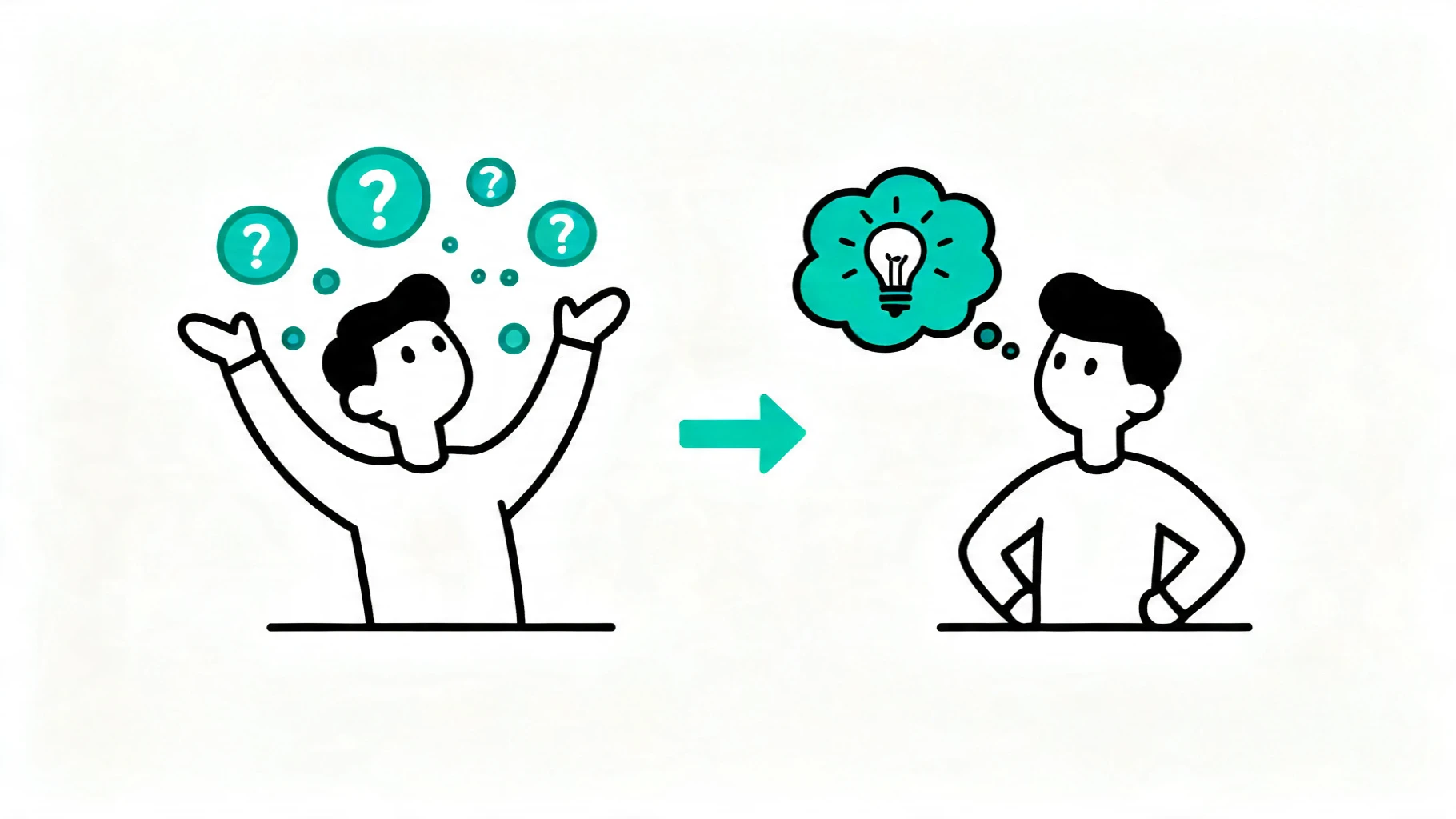
Imagine that you have written something almost every day for a year. Some days it was just a few lines before bed; other days, full pages about a decision, a worry, a trip, a conversation, or simply a day you did not want to forget. By the end of the year, you have hundreds of moments preserved with surprising honesty. You know they are all there, but an unexpectedly difficult question appears: what do you do with all of it now?
This is one of the least discussed problems with keeping a journal. We talk a lot about the benefits of writing, building the habit, and finding a few minutes each day to do it, but much less about what happens afterward. Writing can help you in the moment while also creating a huge archive of your life that you rarely return to.
The problem is not that journaling does not work. The problem is that an important part of its value only appears when what you wrote is able to find its way back to you.
Why do we keep a journal?
The reasons for keeping a journal vary from person to person, but most of them revolve around a few deeply human needs: remembering, understanding, processing, leaving a record, and noticing how we change over time.
We write, first, so we do not lose what we lived through. Memory does not work like a recording. It selects, simplifies, blends events together, and reinterprets the past from the perspective of who we are today. Years from now, you may still remember what happened during an important period of your life, but it will be much harder to remember how you thought while it was happening. A journal preserves exactly that: the version of you that did not yet know how the story would end.
We also write to better understand what is happening to us. Turning a feeling or a worry into words forces us to give it structure. Something that felt vague and chaotic in our minds begins to reveal causes, consequences, contradictions, and possibilities. That is why we often discover what we think while writing. We are not simply recording an idea that already existed; we are shaping it.
Another reason is to process difficult or emotionally complex experiences. Writing creates a small amount of distance between the experience and ourselves. What was endlessly circling in the mind is now in front of us, transformed into language. That does not automatically solve the problem, but it can make it easier to observe and, sometimes, easier to carry.
And then there are two reasons that become more visible with time: leaving a record of our experience and having a conversation with earlier versions of ourselves. There is something deeply human in wanting certain moments not to disappear completely. Sometimes we write for our future self; other times, even if we never say it explicitly, we write so that someone, someday, might understand what the world looked like from where we stood.
Part of the benefit happens while writing. Another part happens when we return.
There is an important distinction here. Some of the benefits of journaling happen immediately. If you write tonight about something that is worrying you, you have already organized thoughts that were previously scattered. If you describe a meaningful day, you have already created a record that tomorrow will no longer depend entirely on memory.
But other benefits require a second action: coming back to read.
To recognize a pattern, you need to compare moments separated by time. To realize that you have been worrying about the same thing for months, you need to encounter several versions of that worry. To notice that something that once felt enormous no longer has much space in your life, you need to see the words you used to describe it back then. And to have a conversation with your past self, you inevitably need to hear that person again.
This is where the traditional journal begins to struggle. After a year, you no longer have just a journal; you have hundreds of entries, thousands of sentences, and dozens of small stories mixed together. You know that somewhere in there is the reflection you wrote after making an important decision, but you probably do not remember when. You know you have written many times about work, family, or a personal project, but reconstructing that evolution would require going back through months of writing.
A journal preserves memory, but it does not necessarily help you find it.
The problem with many journaling apps
Journaling apps have made it incredibly easy to capture our lives. We can write from our phones, add photos, browse by date, receive reminders, and keep years of entries neatly organized. The problem is that most of these tools are designed primarily around the moment of input: open the app, write something, save it.
Once the entry has been stored, it rarely takes part in the experience again.
What you wrote in March stays in March. What you said you wanted to change in January does not appear when you write about the same thing again in September. A worry that appears five times throughout the year still remains five separate entries. An idea that started as a passing thought and eventually became a major project may never appear as one continuous story.
The app preserves every tree, but rarely comes back to show you the forest.
That is why someone can write for months or even years and still end up with a huge archive of their life but very little perspective on what it contains. The problem is not a lack of information. It is the opposite: there is too much information and too few ways to turn it back into context.
What should a year of writing give back to you?
If someone could carefully read everything you wrote over the course of a year, you probably would not want them to simply tell you how many words you wrote, which day you wrote the most, or how many streaks you maintained. Those statistics can be interesting, but they say very little about the life behind them.
What would really matter is discovering what that year was actually about.
Maybe you spent several months trying to solve the same decision without realizing it. Perhaps a worry that once felt permanent disappeared quietly. Maybe a project first mentioned in one insignificant sentence ended up taking over a large part of your year. Or perhaps certain people, places, or ideas kept appearing around important moments.
It would also be valuable to recover your own words at the right time. Reading something today that you wrote exactly one year ago can completely change the way you remember that period. Finding a sentence you wrote before making a decision lets you compare what you imagined then with what actually happened later.
But there is one important condition: your journal should not tell you who you are.
A tool that reads your story back to you should surface evidence, connections, and moments you may have forgotten, while leaving the interpretation to you. Your own words should remain the source. Technology can help connect the dots; it does not need to decide what they mean.
From storing memories to recovering perspective
This difference between storing and recovering is important to us at Deeditt.
From the beginning, Deeditt has been about creating a place where you can keep experiences, ideas, small achievements, and parts of your life that would otherwise end up scattered across notes, photos, and memory. But saving something is only the first half of the problem. If those experiences remain buried after you write them, much of their value is still waiting inside the archive.
That is why we are exploring a second part: helping what you have lived come back to you with context.
In Deeditt, Memories can look back across what you have written from different distances — a week, a month, a quarter, or a year — to reconstruct stories, recover moments, and help you see how certain ideas evolved over time. It is not simply about summarizing entries or generating activity statistics. The goal is to turn a collection of isolated memories into something you can return to and recognize as part of a larger story.
You can read more about that direction in Memory Perspectives, a New Direction.
A journal should not end when you press save
Keeping a journal still has value even if you never reread a single page. Thinking more slowly, naming an emotion, or recording a day you do not want to forget can already justify the time spent writing.
But a journal can offer something more.
With enough distance, our own words become a form of perspective. They allow us to remember not only what happened, but what we expected would happen; to discover worries that quietly disappeared; to recognize ideas that eventually grew into something bigger; and to encounter earlier versions of ourselves that we had almost forgotten.
Maybe that is why, after a year of writing, the question should not be “what was all of this for?” but something slightly different:
how do I make everything I wrote capable of finding its way back to me?
Because everything passes. And when we write it down, something remains. The deeper potential of a journal begins when what remains can become part of our lives again.