The generic-advice trap
Open most journaling apps and you’ll meet the same script: an AI prompt asking how you feel, a tidy reframe, a motivational nudge. It feels personal. It isn’t. A 2025 paper in Frontiers in Psychology by Jeena Joseph warned that when self-awareness — “traditionally developed through practices like journaling, meditation, or therapy — is outsourced to algorithmic systems,” users “begin to trust the algorithm’s reading of things over their own feelings, intuitions, or recollections.” Translation: the more we let chatbots interpret us, the less we know ourselves.
Generic advice has a ceiling. Hoevenaars and colleagues, in a 2020 Nutrients trial, found that participants receiving personalized lifestyle guidance significantly improved their intake of fruit, whole grains, nuts, and fish, “whereas no improvements were observed in the control and [generic advice] group.” The pattern repeats across domains: matched-to-you beats matched-to-everyone. And nothing is more matched to you than your own past.
Your life is the dataset
The quantified-self movement has a name for this: n-of-1. You are the only person whose patterns reliably predict your behavior. In their 2000 Psychological Review paper, Conway and Pleydell-Pearce showed that our remembered experiences form an “autobiographical memory knowledge base” — the actual operating manual we keep ignoring. An AI can guess that mornings are best for creativity. Your notes can prove that you write your sharpest paragraphs at 2 p.m., always after a walk, never on Mondays.
That’s not a generality. That’s evidence.
Why you can’t see your own story
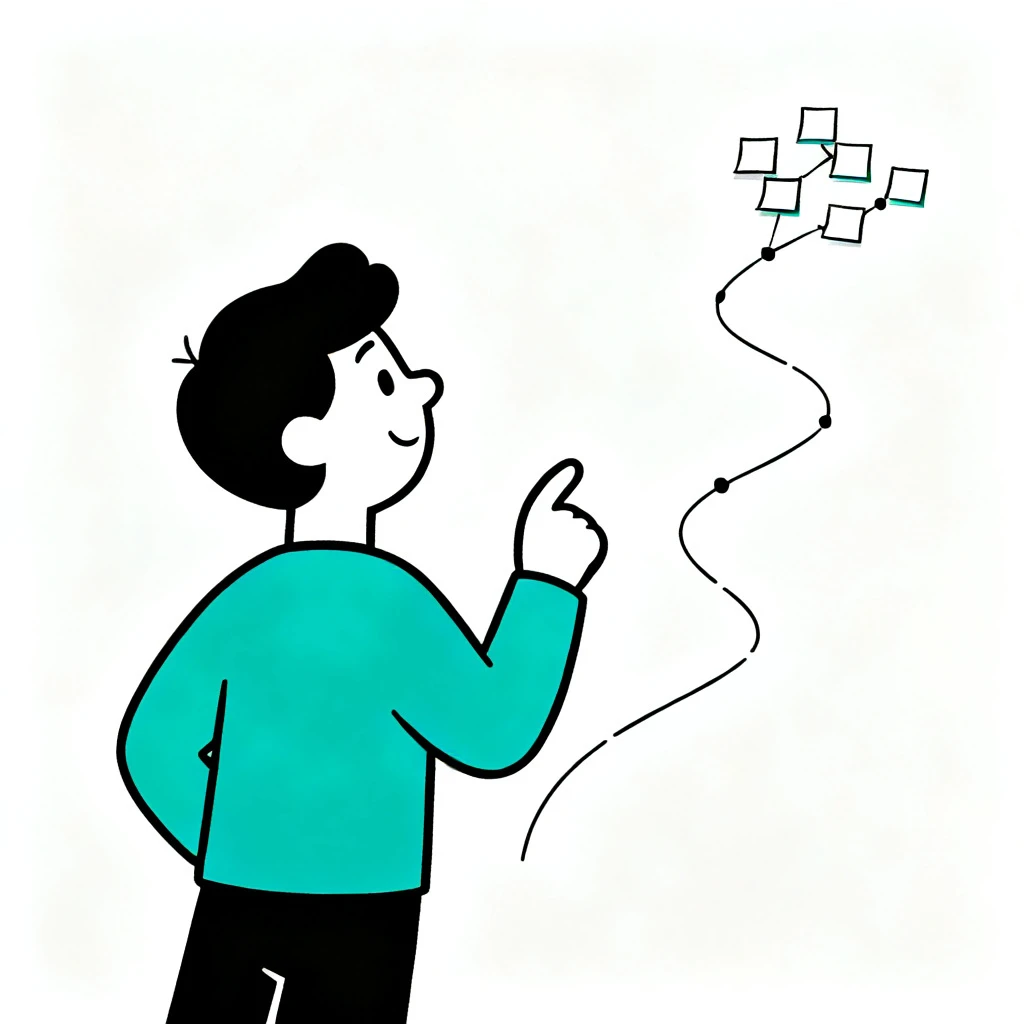
Here’s the catch: experience as it happens is a blur. Habermas and Bluck’s landmark 2000 paper in Psychological Bulletin, “Getting a life,” showed that scattered episodes only become an identity once they’re organized along temporal, biographical, causal, and thematic lines. Until then, you’ve got memories, not a story. As philosopher Mark Freeman puts it in Hindsight (Oxford, 2010), “through the distance conferred by time, we can look back on past experiences and see them anew, as episodes in an evolving story.” You can’t see the arc while you’re inside it. You need to step back, lay the moments next to each other, and let the pattern emerge.
Most journaling apps make this worse — entries pile up chronologically, each one isolated, none in conversation with the next.
Organizing, not outsourcing
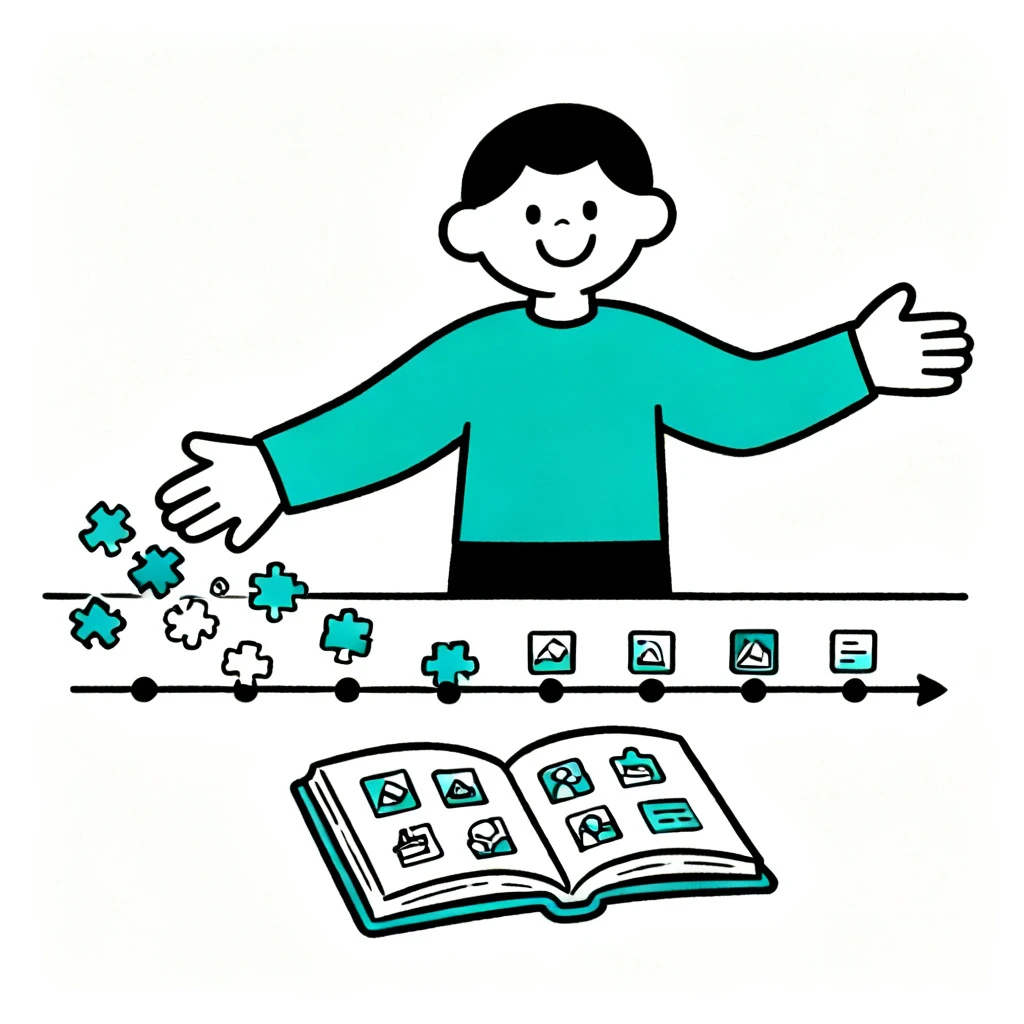
This is why a tool like Deeditt approaches the problem differently. Single moments become Deeds. Deeds connect into Journeys — chaptered arcs around a goal, a transition, a chapter of life. A private Memories space holds the raw reflection. The point isn’t to ask an AI what your life means; it’s to arrange your own evidence until meaning surfaces. As Deeditt puts it: scattered reflections become coherent, you see the patterns, you connect the lessons.
A better question
Stop asking “What should I do?” — the question AI is built to answer with averages. Start asking “What has my life been trying to teach me?” — the question only your own organized story can answer.
Your wisdom isn’t somewhere on the internet. It’s in your timeline, waiting to be connected.