This release, published on May 30, 2026, brings four improvements to how you reflect and understand your life through journaling:
- Memory Episodes that surface long-form narrative arcs across weeks and months
- Memory History to explore your past, find similar moments, and track recurring threads
- Redesigned Insights with a cleaner layout and richer period-based analysis
- More writing space with expanded per-entry and daily character limits
Memory Episodes — your life as a longer story
Single entries give you a snapshot. But patterns — the way anxiety returns every few months, the way creative energy follows rest, the way certain relationships pull at you in cycles — only show up across time.
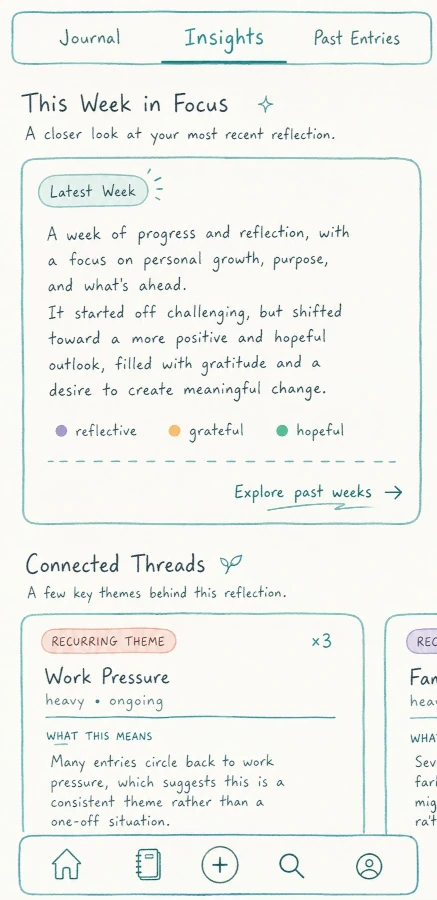
Memory Episodes are long-form narrative arcs built automatically from your connected entries. They come in several types: recurring threads, recovery arcs, identity threads, steadying threads, and repeating patterns. Each episode shows its current status — open, shifting, resolved, or steady — and how it connects to other episodes in your life.
This gives you something no single week of journaling could: a map of your longer story. You can see how today connects to three months ago, and what usually happens next.
Memory History — your past holds answers
The History tab is a new section in Memories built around a simple idea: understanding the present is easier when you can see the past clearly.
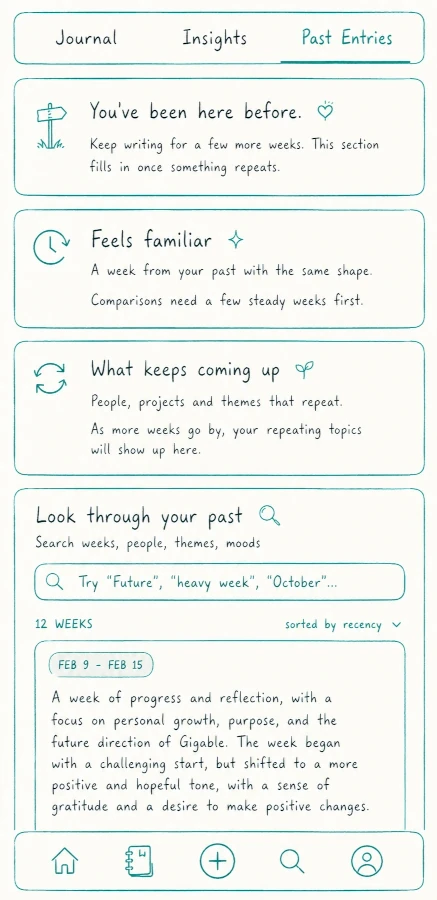
You can browse your full archive of past weeks, search by date, person, or topic, and find past weeks that closely matched your current emotional state. You can see how long a recurring pattern took to resolve last time, and what themes tend to appear together.
History also shows recurring threads organized by category — people, projects, themes, places — with timestamps for when each last appeared. Pattern recognition, built into your journal.
Redesigned Insights — one coherent flow
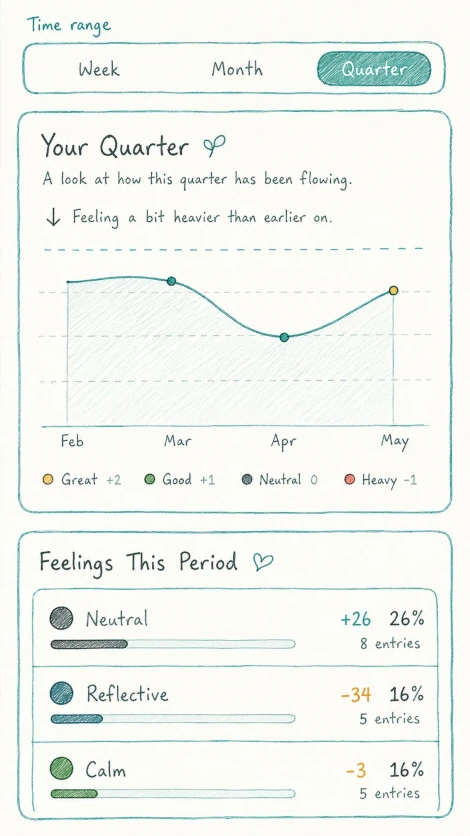
The Insights section has been rebuilt from the ground up. Where the old layout stacked cards without a clear hierarchy, the new design leads with your weekly reflection, then unfolds into supporting storylines, episode arcs, a period selector (7 days, 30 days, 90 days), mood trend charts, feeling distribution, and sleep and energy summaries — all in a single coherent flow.
You can now move from a quick weekly summary to a deep three-month analysis without losing your place. The layout guides you through your data rather than presenting it all at once.
More room to write
A small but meaningful change: the per-entry character limit has been raised from 240 to 300, and the daily total from 700 to 1,000 characters.
Some days need more words. These expanded limits give you room to capture what matters without cutting short something important.